
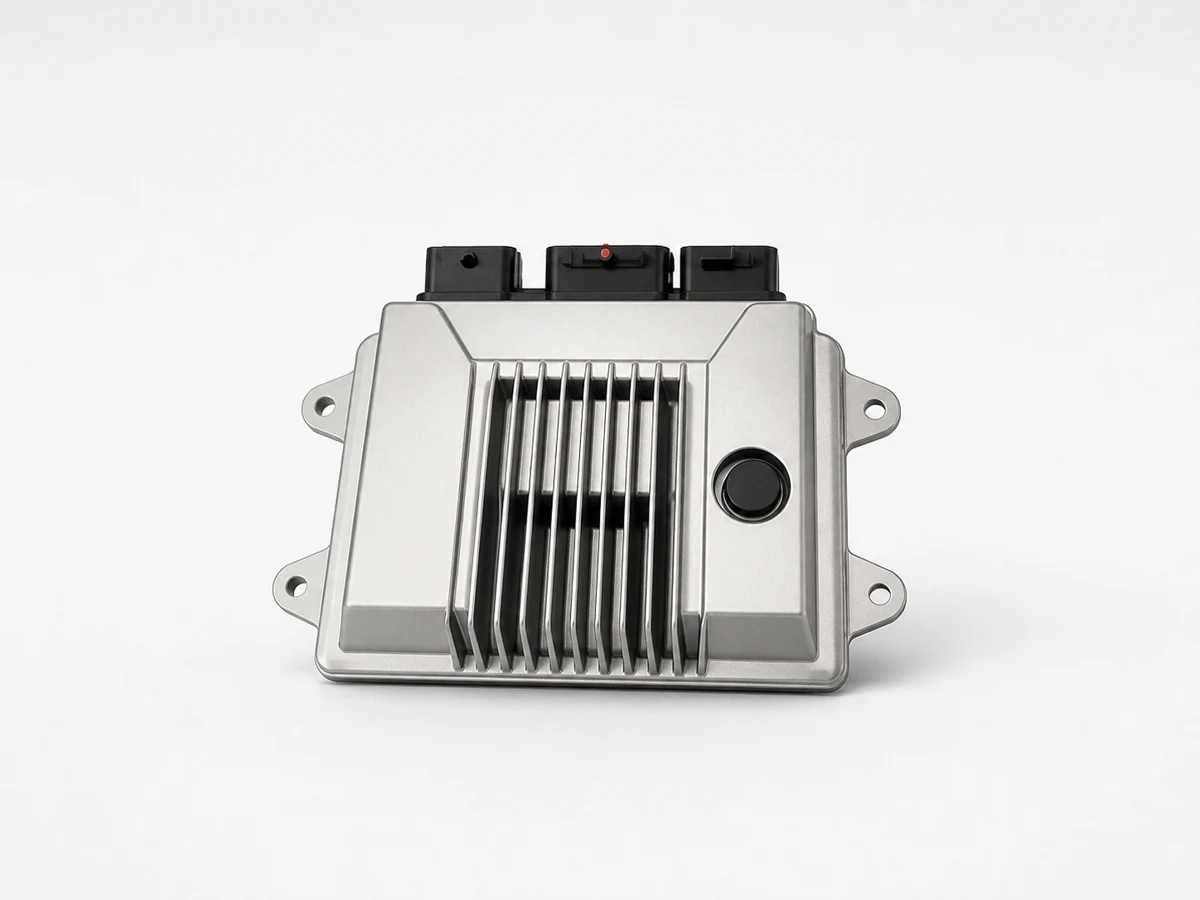
KCU GEN2
A high-performance vehicle controller with Infineon TC387 multi-core processing, CAN FD, Ethernet, and rich I/O for SDV, EV, and EVCC applications.
Positioning
A high-performance vehicle controller with Infineon TC387 multi-core processing, CAN FD, Ethernet, and rich I/O for SDV, EV, and EVCC applications.
Built for high-performance VCU, domain controller, SDV, and next-generation EV platforms.
Improves compute, networking, and I/O expansion over GEN1 for more complex control strategies.
Can serve as the hardware basis for EVCC or advanced VCU programs.
Key Advantages
Multi-Core Compute
Infineon TC387 with 4 TriCore 300MHz for demanding vehicle-control and communication workloads.
High-Bandwidth Networking
CAN 2.0B / CAN-FD, LIN Master, and Ethernet support next-generation vehicle networks.
Rich I/O
20 analog inputs, 22 digital inputs, 4 frequency inputs, and 34 power outputs.
Expandable Applications
Extends to EVCC, domain control, and SDV data-integration scenarios.
System Architecture
High-Performance Core
TC387 multi-core MCU handles real-time control, communication management, and advanced vehicle application logic.
Vehicle I/O and Drivers
Analog, digital, and frequency inputs plus high-side / low-side PWM driver outputs.
Vehicle Network Expansion
CAN FD, LIN, and Ethernet connect BMS, motor controllers, charging systems, and vehicle-gateway functions.
Safety Architecture
MCU Protection Mechanisms
- Lockstep CPU mechanism
- Flash / RAM error detection and correction
- MPU memory protection to restrict Flash and RAM access by configured modules
- MBIST / LBIST power-on and self-test features
SBC Protection Mechanisms
- Power monitoring for VDD, ADC reference, and CPU core voltages
- External watchdog for safety-critical tasks
- Power-on self-test of the chip
Input and Output Chip Diagnostics
- Output short-circuit detection
- Input fault detection
- Sensor power supply short-circuit protection
Security Architecture
Secure Boot
Supports secure boot trust-chain signature verification to ensure bootloader and application integrity and prevent unauthorized program execution.
Secure Programming
Uses authentication, authorization, and encryption during software download so only authorized software can be programmed into the controller.
Secure Diagnosis
Supports CMAC / HMAC unlock with HSM-managed keys, restricting diagnostic access and protecting diagnostic data.
Secure Communication
Supports AUTOSAR SecOC for encrypted communication and message verification, protecting confidentiality and integrity between controllers and external networks.
Specifications
| Main CPU | Infineon TC387 |
|---|---|
| CPU Clock | 4 TriCore 300MHz |
| Memory | 10 MB Flash / 1.5 MB SRAM |
| Platform | High-performance automotive controller platform |
| Supply Voltage | DC 9-36V |
|---|---|
| Sensor Supply | 4 channels of 5V sensor supply |
| System Fit | For 12V / 24V vehicle systems and next-generation EV platforms |
| Analog Inputs | 20 analog inputs |
|---|---|
| Digital Inputs | 22 MSDI digital inputs |
| Frequency Inputs | 4 frequency inputs |
| Use Case | Multi-sensor, switch, and periodic-signal integration |
| Low Side Drivers | 28 low-side driver outputs with PWM support |
|---|---|
| High Side Drivers | 6 high-side driver outputs with PWM support |
| Communication | 4 CAN 2.0B / CAN-FD, 1 LIN Master, 1 Ethernet |
| Connector | Molex 112 pins |
| EVCC | Electric Vehicle Communication Controller expansion |
|---|---|
| SDV / EV | Supports SDV and EV control platform development |
Software & Integration
Automotive Design Direction
Applications
Advanced VCU
Integrates powertrain, energy, chassis, and network data for next-generation vehicle control.
SDV / Domain Control
Higher compute and Ethernet support software-defined vehicle architectures.
EVCC / Charging
Can serve as the hardware base for EV charging communication and control functions.
Need KCU GEN2 evaluation or custom high-performance control?
We can help plan KCU GEN2 integration around SDV architecture, domain-control functions, in-vehicle networking, EVCC expansion, and I/O load requirements.